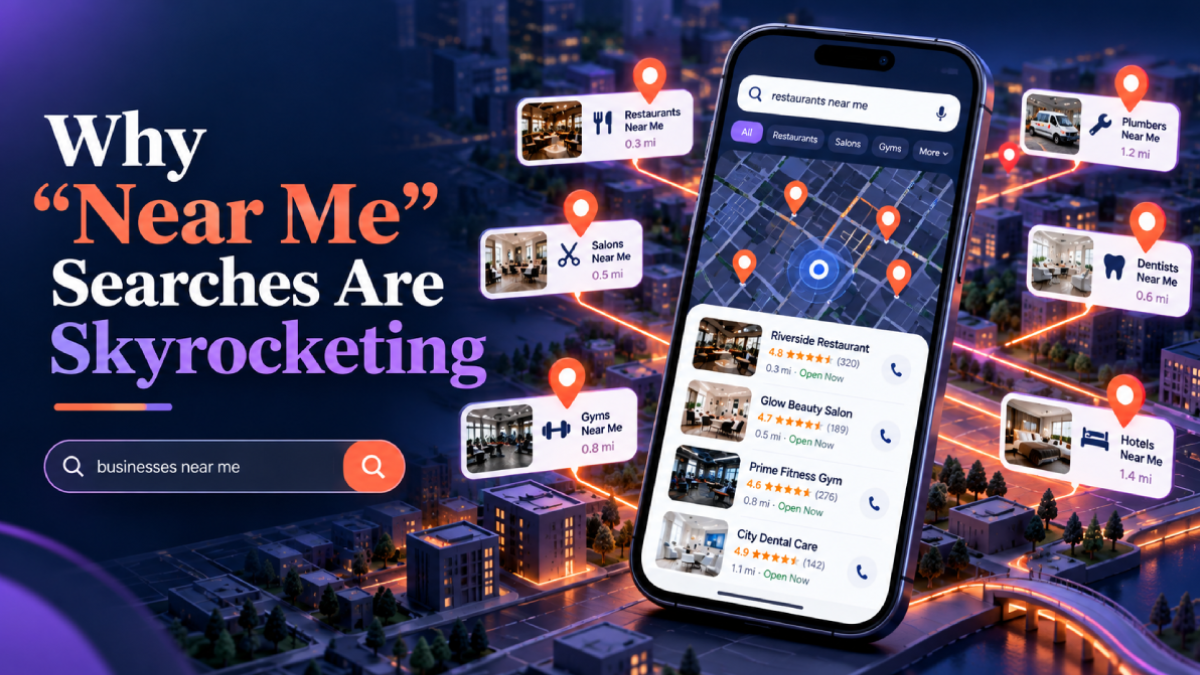
When people need something nearby, they increasingly turn to online search instead of relying only on traditional directories, advertisements, or recommendations. A person looking for a restaurant, plumber, salon, mechanic, hotel, doctor, retailer, or other service may simply search for what they need followed by “near me.”
These searches reflect a practical customer need: find a relevant business nearby and decide what to do next.
For local businesses, understanding this behavior is important. Being discoverable online can help potential customers find basic information about a business when they are actively looking for a product or service.
But why are “near me” searches becoming so important, and what can small businesses do about them?
What Are “Near Me” Searches?
A “near me” search is a location-oriented search query where someone uses terms such as:
- “restaurants near me”
- “coffee shops near me”
- “plumbers near me”
- “car repair near me”
- “dentist near me”
- “hotels near me”
- “gift shops near me”
The phrase “near me” does not necessarily mean customers only search those exact two words. Search engines can also understand location and intent from other queries.
For example, someone may search for “Italian restaurant in downtown Singapore” rather than “Italian restaurant near me.” Both searches can indicate local intent.
The underlying goal is similar: find a relevant business in a particular area.
Why Are “Near Me” Searches Growing?
1. Smartphones Make Local Search Convenient
Mobile devices have changed how people look for businesses.
When someone is already out shopping, traveling, commuting, or exploring an unfamiliar area, their phone can become a quick tool for finding nearby businesses.
Instead of planning everything in advance, customers can search when a need arises.
That creates opportunities for businesses that maintain a useful and accurate online presence.
2. Customers Want Immediate Solutions
Many local searches have strong practical intent.
Someone searching for “bakery near me” may want to buy something soon. Someone searching for “car repair near me” may need assistance with their vehicle. A person searching for “hotel near me” may need accommodation in the immediate area.
This makes local search particularly valuable because the search can occur close to the point at which the customer is ready to take action.
However, a local search does not guarantee that a customer will contact or visit a business. Competition, relevance, distance, business information, reviews, pricing, availability, and other factors can influence the final decision.
3. Search Engines Understand Location Better
Modern search engines use various signals to provide results that are relevant to a user’s location and search intent.
Google explains that local results are primarily influenced by relevance, distance, and prominence.
This means businesses should not focus solely on inserting “near me” into their website content.
Instead, they should make it easy for search engines and customers to understand:
- What the business offers
- Where it operates
- Which customers it serves
- How to contact it
- What category it belongs to
- What products or services are available
4. Customers Can Compare Businesses Quickly
Local search is no longer simply about finding the nearest business.
Customers can often compare multiple options before making a decision.
They may look at:
- Business information
- Website
- Photos
- Reviews
- Opening hours
- Services
- Location
- Contact details
This means your online presence needs to do more than simply establish that your business exists.
It should provide enough accurate information to help potential customers understand whether your business is relevant to them.
How Can Small Businesses Prepare for “Near Me” Searches?
Keep Your Business Information Accurate
Start with the basics.
Make sure your business name, phone number, website, address or service area, operating hours, and other important information are accurate.
If these details change, update them across important online platforms.
Optimize Your Website for Local Intent
Your website should clearly communicate what you offer and where you operate.
Use natural language to describe your services, locations, products, and customer needs.
Avoid repeatedly adding phrases such as “best [service] near me” to pages simply to target the keyword. Search engines are designed to understand natural language and user intent, so useful content should come first.
Maintain Your Google Business Profile
For eligible businesses, a Google Business Profile can help present important information about the business on Google Search and Maps.
Google recommends keeping business information complete and up to date.
Business owners should regularly review their profile and make appropriate updates.
Get Listed in Relevant Online Directories
Online business directories provide another way for potential customers to discover a company.
A directory listing can communicate important details such as your business category, location, services, website, and contact information.
The objective should not be to submit your business to every directory available. Focus on relevant, trustworthy, and useful platforms where your potential customers may actually look for businesses.
Why Online Business Listings Matter
A customer may discover your business through a search engine, social platform, recommendation, or online directory.
Your business listing can help provide consistent information during that discovery process.
LocalXReach gives businesses an online platform where they can create a business listing and make information about their business available for online discovery.
List your business on LocalXReach
For small businesses, this can be one practical part of building a broader online presence alongside a website, local search profile, reviews, and other relevant marketing channels.
What Should a Local Business Listing Include?
When creating a listing, aim to provide useful information rather than simply filling in the minimum fields.
Depending on the platform, consider including:
- Business name — Use your actual business name.
- Business category — Select the most relevant category available.
- Description — Clearly explain what you offer.
- Location or service area — Tell customers where you operate.
- Contact details — Provide accurate ways to reach you.
- Website — Give customers a way to learn more.
- Services or products — Explain what customers can expect.
- Photos — Use appropriate, current images where supported.
Keeping this information accurate is more valuable than trying to manipulate search results with excessive keyword repetition.
“Near Me” Searches Are About Intent, Not Just Keywords
One of the biggest mistakes businesses can make is treating “near me” as just another keyword to insert into website copy.
The more useful question is:
What does someone searching for my business locally need to know?
If someone searches for a local service, they may want to know whether you serve their area, what you offer, when you are available, how to contact you, and whether your business appears trustworthy.
A strong local presence addresses those needs.
Conclusion
The rise of “near me” searches reflects a broader change in how customers discover local businesses. People increasingly use online search to find nearby products and services, compare options, and decide which businesses to contact.
For small businesses, the response should not be simply adding the phrase “near me” throughout a website. A better approach is to build a complete and accurate online presence that clearly communicates what you offer, where you operate, and how customers can reach you.
That can include your website, Google Business Profile where eligible, relevant online directories, business listings, and genuine customer reviews.
If you want to give potential customers another way to discover your business online, list your business on LocalXReach and provide clear, useful information about what you offer.
Want to make your business easier to discover online? List your business on LocalXReach and give potential local customers another way to find your business and learn what you offer.
Frequently Asked Questions
What does a “near me” search mean?
A “near me” search is a location-oriented search used to find businesses, services, products, or places close to the searcher’s current or intended location.
Why are people using “near me” searches?
They offer a convenient way to find relevant local options when customers need something nearby. Mobile devices and location-aware search experiences make this particularly convenient.
Do businesses need to use “near me” repeatedly on their website?
No. Businesses should not rely on keyword repetition. Instead, create useful content and clearly communicate your services, location, service area, and other information relevant to local customers.
Do online directories help with local discovery?
Relevant online directories can provide another place where customers can discover business information. Their value depends on the platform, relevance, listing quality, and how customers use it.
How can I improve my local search visibility?
Start with accurate business information, a useful website, a properly maintained Google Business Profile where eligible, relevant business listings, and genuine customer reviews. Continue monitoring and updating your online presence.
Should every business create a local listing?
If your business serves a local market and the platform is relevant to your customers, a business listing can be a practical part of your online presence. Choose platforms that genuinely support business discovery rather than creating listings indiscriminately.