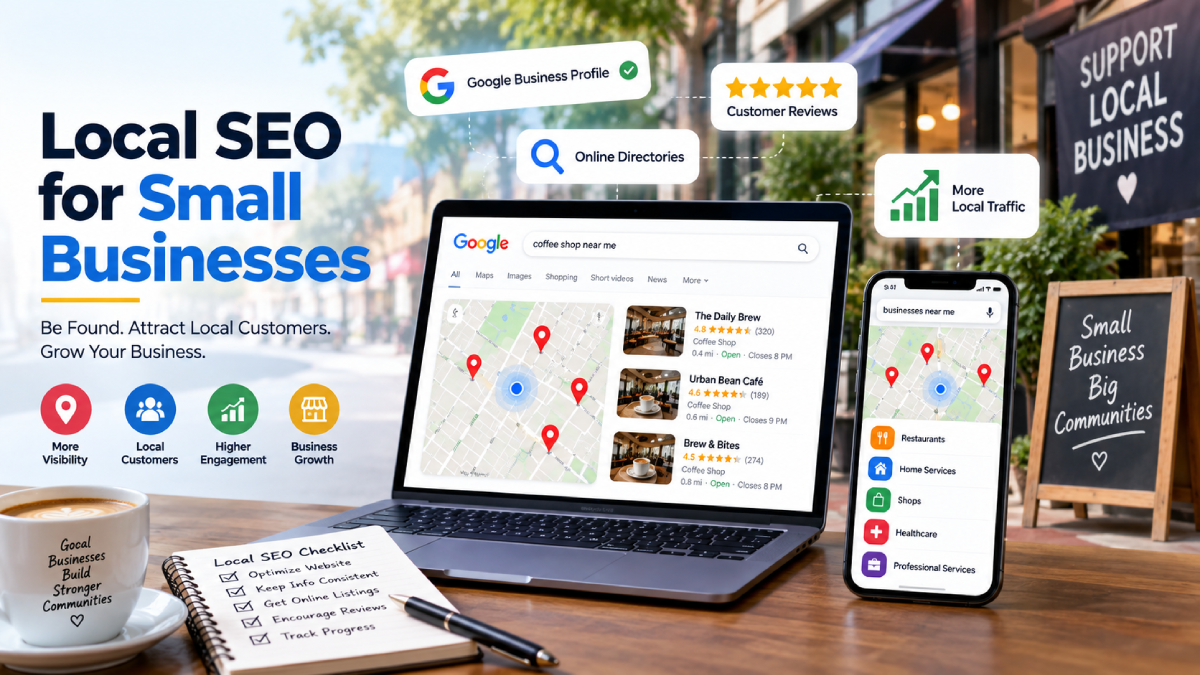
For a small business, being visible to customers in your local area can be just as important as having a good website. When people search for services, products, restaurants, professionals, or businesses nearby, they often use Google Search or Maps to find their options.
That is where local SEO for small businesses becomes important.
Local SEO is the process of improving your online presence so search engines can better understand your business, location, products or services, and relevance to local searches. It can help customers discover your business when they are searching for what you offer.
Local SEO is not about guaranteeing a particular Google position. Instead, it is about creating accurate, useful, and consistent information across your website and relevant online platforms.
What is Local SEO?
Local SEO is search engine optimization focused on helping a business become more discoverable for searches connected to a specific location.
For example, someone might search for:
- “plumber near me”
- “Italian restaurant in New York”
- “accountant near me”
- “best coffee shop in [city]”
- “roof repair service”
- “dentist near me”
Google says local search results are primarily influenced by relevance, distance, and prominence. Providing complete and accurate business information can help Google understand how your business relates to relevant searches.
Why Does Local SEO Matter for Small Businesses?
Small businesses often serve specific communities, cities, neighborhoods, or service areas. Local SEO helps connect the information about your business with people searching for relevant products and services.
A strong local presence can make it easier for potential customers to find:
- What your business does
- Where you are located
- Which areas you serve
- How to contact you
- Your website
- Business hours
- Products or services
- Customer reviews and other useful information
The goal is simple: make it easier for relevant local customers to discover and understand your business online.
1. Create and Maintain Your Google Business Profile
For eligible businesses, a Google Business Profile is an important part of local search visibility. Google describes Business Profiles as a way for businesses to appear on Google Search and Maps with information such as location, contact details, website, hours, photos, and reviews.
Make sure your profile information is accurate and complete.
Pay particular attention to:
- Business name
- Primary category
- Address or service area
- Phone number
- Website
- Business hours
- Services
- Photos
- Business attributes
Google specifically recommends keeping business information complete and up to date.
2. Optimize Your Website for Local Search
Your website should clearly explain what your business offers and where you operate.
For example, a local service business can naturally mention its service areas and important services on relevant pages. Avoid creating repetitive pages simply to target different locations.
Useful website elements can include:
- Clear business information
- Service pages
- Location information
- Contact page
- Descriptive page titles
- Helpful local content
- Internal links between relevant pages
- Mobile-friendly design
Write primarily for customers. Location and service keywords should appear naturally rather than being repeatedly inserted into every sentence.
3. Keep Business Information Consistent
Your business name, address, phone number, website, and other core details should be accurate across important online listings.
Inconsistent information can create confusion for customers and make it harder to establish a reliable online presence.
Review your important listings periodically, especially after changing your:
- Phone number
- Address
- Website
- Operating hours
- Service area
- Business name
4. Get Listed in Relevant Online Directories
Online business directories can provide another way for customers to discover your company.
Rather than submitting your business to every directory available, focus on relevant and useful platforms.
A quality business listing can include your:
- Business name
- Category
- Description
- Website
- Contact details
- Location or service area
- Products or services
- Photos
LocalXReach provides businesses with an online platform to create a business listing and make business information available for discovery.
5. Encourage and Manage Customer Reviews
Reviews are an important part of how customers evaluate local businesses. Google also notes that reviews and positive ratings can contribute to local prominence.
Encourage genuine customers to leave honest feedback where appropriate. When customers leave reviews, respond professionally and address legitimate concerns constructively.
Never create fake reviews or manipulate ratings.
6. Use Local Business Structured Data When Appropriate
Structured data can help search engines understand information about your business.
Google’s documentation explains that LocalBusiness structured data can communicate details such as business hours and other business information. Google recommends validating structured data and following its guidelines.
This is generally a technical SEO task, so businesses using WordPress or another CMS may want help from a qualified developer or SEO professional.
7. Measure Your Local SEO Progress
Local SEO should be treated as an ongoing process rather than a one-time task.
Track useful indicators such as:
- Organic website traffic
- Local search queries
- Website enquiries
- Phone calls
- Direction requests
- Business Profile interactions
- Listing traffic
- Customer reviews
Google Business Profile provides performance information showing how customers discover and interact with a profile on Search and Maps.
A Simple Local SEO Checklist
If you are new to local SEO, start with these steps:
- Create or claim your Google Business Profile if eligible.
- Complete your business information accurately.
- Optimize important website pages.
- Keep business information consistent.
- Create relevant online business listings.
- Encourage genuine customer reviews.
- Add appropriate structured data.
- Monitor your website and local search performance.
- Update information whenever your business details change.
Frequently Asked Questions
What is local SEO for small businesses?
Local SEO is the process of improving a business’s online presence to make it easier for people searching for relevant products or services in a specific geographic area to discover it.
Is local SEO only for businesses with physical stores?
No. Businesses that travel to customers or serve defined local areas can also benefit from local SEO. Google states that eligible businesses can include those with a physical location or those that travel to customers.
How long does local SEO take to work?
There is no universal timeframe. Results can vary depending on competition, location, website quality, business information, authority, and other factors. Local SEO should be approached as an ongoing process rather than a guaranteed short-term result.
Do online directories help local SEO?
Relevant business directories can support online discoverability and provide additional places where customers can find business information. They should complement—not replace—your website and other local marketing efforts.
What are the main local SEO ranking factors?
Google says local results are primarily based on relevance, distance, and prominence.
Can a small business do local SEO itself?
Yes. Business owners can handle many foundational tasks themselves, including maintaining accurate business information, improving website content, managing listings, and responding to genuine customer reviews. More technical tasks may require professional assistance.
Conclusion
Local SEO for small businesses starts with the basics: accurate business information, a useful website, a properly managed Google Business Profile where eligible, relevant online listings, genuine customer reviews, and consistent information across important platforms.
You do not need to do everything at once. Start by making your business information complete and accurate, then gradually build a stronger local online presence.
For another practical way to make your business discoverable online, consider creating a listing on LocalXReach.
Make your business easier to discover online. List your business on LocalXReach and give potential customers another place to find accurate information about what you offer.